


Singapore’s Albatross File: The rough cut of a national divorce

Updated: Mar 9
Never before had I been handed a piece of Singapore’s history and told to judge it for myself. That was what struck me first about The Albatross File exhibition: this unsettling invitation to reconsider a story I thought I already knew.
I was seated in a holding area just outside the exhibition at the National Library where a group of us from the Library Association of Singapore were welcomed and briefed before our tour. Gene Tan, the chief librarian and creative lead behind the exhibition, walked us through how the file had landed in his hands and what the brief had been. Just before ushering us through the doors, he said something I wasn’t expecting: the exhibition was kept deliberately neutral. Just the documents, presented as they were, for us to interpret on our own.
For a file the state had kept locked away for sixty years, that felt like a dare.
"Now I am going to let you into what has been a state secret up to now. This is a file which I call Albatross." - Goh Keng Swee
This quote greeted us the moment we stepped through the doors. The gallery was crowded, noisy even — unusual for a library exhibition — with groups huddled on their own guided tours, voices overlapping. Before I could lean in to eavesdrop, Gene gathered us for a group photo beneath the quote. With the group squeezed under those words, we smiled for about ten photos. Somewhere around the fifth, my smile became fixed and the term ‘state secret’ began taking root.
I had pointedly avoided the Reddit threads, the press coverage, all of it, as I wanted to walk in uninfluenced. And here was Gene, telling us the exhibition had been designed with that same intention. I was aware, standing there with a smile still set on my face, that ‘state secret’ was where my mind had already landed.
“State secret to whom?” I found myself thinking. The government? The public? Or, in some strange way, to ourselves? For sixty years that document had belonged to a second‑person noun: them. The state would decide when it was safe to see. Careers were built on not seeing it. Textbooks were written in the dark of it. And here I was now, standing under those same words, smiling for a photo, being quietly told that the last six decades had been a long, collective pause in asking, What actually happened over those 23 months?
“23 months in 22 minutes,” Gene had said as we filled into the “Room.” A sweeping, panoramic screen retold the critical months leading up to Singapore’s separation from Malaysia in 1965. For 22 minutes, I watched, captivated, listening to voices I had never heard before, watching decisions unfold in real time, feeling the weight of negotiation, exhaustion, and fear.
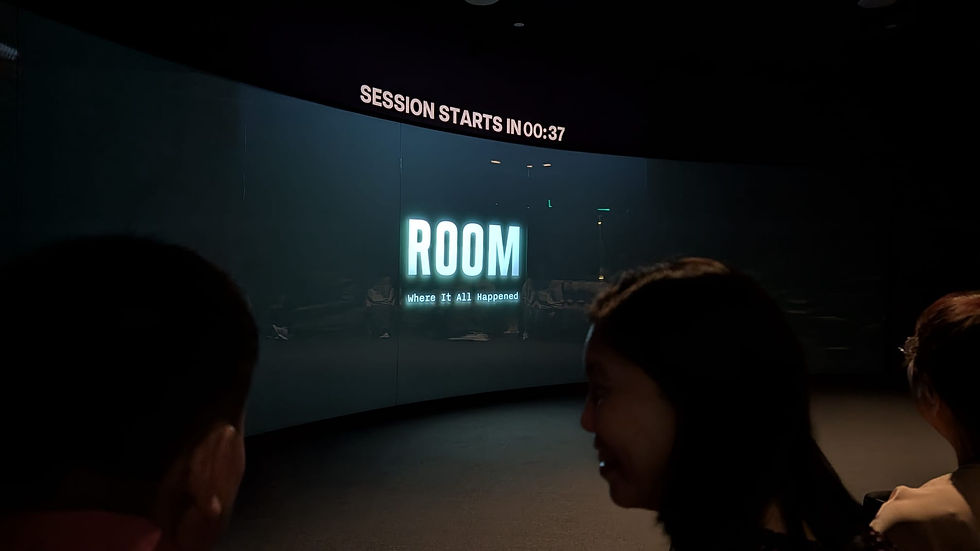
Much of the film centres on the tense negotiations and emotional decisions made by our founding leaders, including Lee Kuan Yew and Dr. Goh Keng Swee. As the plot unfolded, my sense of citizenship began to feel like a house I had unknowingly been barred from entering my whole life—now suddenly opened, a key slipped into my hand mid‑tour, with no instructions on what to do once I stepped inside.
22 minutes later, we filed out of the “Room” as an usher led us to the rest of the gallery. The archives, the generational development, the ChatBook where Gene shared how artificial intelligence is employed by secondary schools to educate their students. And as we passed each gallery, I was mentally reframing them.
Archival secrecy: The fact that this file did not sit in a minister’s cabinet but in an archival vault, indexed under neutral codes, read only by cleared officers and researchers who signed in under heavy conditions.
Generational secrecy: The way the public story of 1965 was handed down as clean gospel. “We were expelled; we survived”—while the bargaining, the exhaustion, the mutual fear that sits in the Albatross notes stayed in a box. I studied the neatly typed documents and listened to the oral files, with half of my mind re-enacting how passionately the younger me had discussed the expulsion with my peers.
Emotional secrecy: The hush around documents that describe hurt, humiliation, even anger directed at living figures. I was feeling the current‑day tension in the gallery: the exhibition displays it, but no one seemed to dare talk about it out loud.
And so each zone becomes a layer of the same question: Who was protected by keeping this secret—and who was handicapped? Has secrecy truly ended, or simply been outsourced to a voice politely holding the door half open?
I opened my email from the gallery booking as soon as I left and viewed the exhibition guide PDF again. It felt oddly personal now, as if I had been given a sealed letter addressed to the version of me who once thought history was whatever the lecturer read from the slides, who never imagined she’d one day stand under Goh Keng Swee’s warning that this was a file to be treated like an “albatross on the neck.”
I decided to take a longer walking route that afternoon. I stuck my headphones in, put on nothing, and let my steps sync with the hum of the odd zoom of scooters slicing between traffic lights. By the time I got home, the afternoon had folded itself around three quiet questions:
Why had this file been locked away for so long?Why was I only being handed it in my forties, when the country itself was turning sixty?And what exactly had they been protecting all this time?
The 30‑year rule is standard for declassification in many Westminster systems. Documents pile up in government offices, then, thirty years later, they reappear like dusty volumes pulled down from a high shelf: watermarked, sometimes redacted, but finally visible. There is comfort in that rhythm: a sense that history will, in time, sort itself out, that enough mouths will have grown quiet and enough grudges will have cooled.
Singapore did not keep that rhythm.
The Albatross File remained sensitive for sixty years—twice the usual run. Goh had told them to burn the notes in 1965. This desperate reflex, perhaps the wish of a man who realised he had written the internal script of a rupture that would shape a nation.
Singapore did not burn the file. By the time it formally entered the custody of the National Archives of Singapore in 1996, it had become something between a national artefact and a national migraine. We all have family secrets we only share once the “children” are old enough to handle the weight. A divorce is briskly labelled “uncoupling” in conversations. A parent’s compromise or betrayal emerges only when the audience no longer expects its heroes to be pure.
Singapore, I have learned, had its own version of that holding pattern. The separation story was handed down as a clean, emotional arc: the island expelled, frightened, and then stubbornly rebuilding. It gave the first generation a myth that was simple enough to carry through speeches, textbooks, and National Day parades.
The Albatross File contains the rough cut of that story. The haggling, the casual insults, the stunned disbelief that what felt like a political marriage in 1963 could turn into a constitutional divorce so fast. It shows Singapore not merely as the party being thrown out of the house, but as also one of the people who helped draft the eviction notice. It complicates blame, multiplies responsibility, and forces a country to admit that some of its foundational pain was also, in part, self‑chosen.
The sixty‑year cage was a test of patience and of nerve. It asked again and again whether Singapore was ready to look at 1965 without flinching, without collapsing into wounded pride or defensive nostalgia. Was the economic success strong enough to stand beside the confusion of those months? Was the idea of a Singaporean identity deep enough to survive learning that separation came from a shared choreography?
When the state finally declassified the Albatross File and placed it, lightly glossed but largely unvarnished, in that National Library exhibition hall, it was doing more than releasing archives. It was staging a small transfer of ownership: the secret is no longer theirs; it is now also ours.
This is Singapore’s “coming of age” moment. We are no longer being asked to be a dutiful child and told not to peek under the bed. Now, for the first time, we are being treated as adults invited into the archive room, handed a key, and quietly told, in the tense silence between display case and visitor:
Here is the part of us we did not want you to know. Now that you’re old enough, what will you make of it?


Comments