


Singapore Hainan Hwee Kuan: A temple, a meal, and 171 years of Hainanese heritage on Beach Road

A casual stroll down Beach Road, right in the middle of the CBD, led us to something that felt oddly untouched by time. Between high-rise glass buildings and constant traffic stood the entrance to the 171-year-old Singapore Hainan Hwee Kuan (新加坡海南会馆) at the Kheng Chiu Building.
A traditional paifang stretched across the doorfront, red lanterns hanging along the traditional Chinese tiled roofs, guardian lions flanking the entrance, and a Mazu statue holding her ground. Against a backdrop of steel, glass, and speed, the whole scene felt almost defiant, like a pocket of history refusing to be rushed.
Something else caught our eye: a banner stating that all members of the public are welcome to visit for the “appreciation of local Hainanese cultural practices.”
I’m no Hainanese, unless the exorbitant amount of Hainanese chicken rice I’ve consumed over the past decades has somehow become part of my DNA. Still, the message felt warm and inviting, the very opposite of intimidating.
Just beyond the entrance, we spotted another arched doorway: the temple space tucked further inside. It was almost easy to miss if you were in a rush, but the red glow hinted at something with deeper history, sitting within the building.

Before we could venture further, we were greeted by friendly staff from the eatery, Lao Ba Cha (老爸茶). Their warm, enthusiastic welcome emboldened us to ask – wildly out of character for two introverts – if we could dine inside the banquet hall, nestled between the main dining area and the temple.
The banquet hall was lined with photographs of clan members, wooden inscribed banners, and plaques. A bulletin board nearby was peppered with upcoming events, and a quick deep dive later revealed that the hall often hosts lectures, talks, and forums dedicated to preserving Hainanese heritage and culture.
Though it looked ready for such large-scale gatherings, that Friday afternoon, it was empty except for two inquisitive individuals.
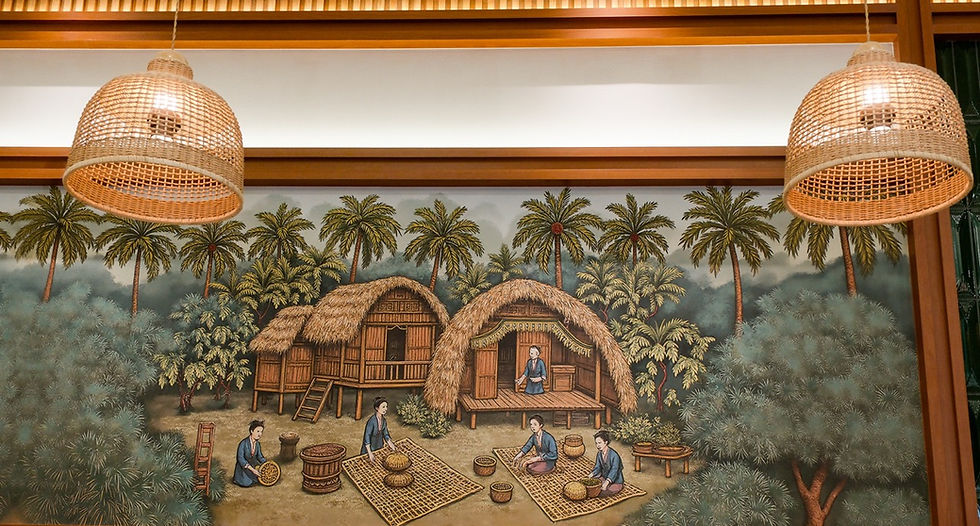
After soaking in the grandeur, we finally placed our order at the eatery. Lao Ba Cha serves traditional Hainanese comfort food, a sentiment echoed not just in the menu but in the space itself. Old-school window grilles, tiled floors, well-worn seating, and intricate lanterns made it feel as though we’d been gently transported back in time and teleported straight to the island of Hainan.
Tricia went for the Pork Chop Curry Rice, while I ordered the Chicken Cutlet Curry Rice, both priced at $6.80. Even the ordering process felt friendly and down-to-earth, with the staff casually asking if we were "vloggers" and smiling when we shared the purpose of our unexpected visit.
Somehow, during that brief exchange, our food was already prepared. Plates of glossy goodness arrived promptly, and at first glance, it was clear they weren’t stingy with portions.
The curry sauce generously coated a mound of rice, accompanied by a fried egg, and chunky pieces of meat and vegetables.
Back in what now felt like our little lair, we dug in. The rice was well-cooked and moist, the curry sauce slightly sweet and not overly spicy. The meat had a good bite to it, with the pork chop clearly tenderised flat for easier chewing. The vegetable side also had black fungus, glass noodles, cabbage, and mushrooms, which added texture to balance the richness of the egg and sauce. Overall, it was comforting and homely, much like the service we had been showered with throughout.
Although we wouldn’t classify the meal itself as unique, having it in the middle of the banquet hall felt surreal, with the red glow from the temple lamps spilling softly into the space. Even as a Buddhist, I’ve never dined so close to a temple before, so the experience felt unusual, yet calming and strangely familiar.
In between bites, we caught glances of regulars moving in and out of the temple, the banquet hall acting as a bridge between two worlds. And as my plate slowly emptied, I realised I was increasingly tempted to light an incense stick of my own.

Midway through our meal, Dominic, the manager of Lao Ba Cha, came over to chat. We learnt that the eatery had only opened five months ago, and that the current space used to be an office before being transformed into an eatery inspired by Hainan Island’s version of a kopitiam, laobacha, traditionally places where Chinese tea is served by the pot.
Dominic himself is Hainanese, and he shared how meaningful it was for him to run the eatery within the Hainan Hwee Kuan. His passion and generous knowledge-sharing made us appreciate the space we were sitting in even more.
Through these conversations, the history of the place slowly revealed itself. The Singapore Hainan Hwee Kuan was founded in 1854 by clan members from Qiongzhou county in Hainan, China, making it one of Singapore’s oldest registered societies. Formerly known as Kiung Chow Hwee Kuan, the association has stood here for over 170 years. Dominic mentioned that the temple inside existed before the building. So the Hainan association was built around it, not the other way around.

This fun fact only fuelled my curiosity further. We finally began our small temple expedition into Tin Hou Kong (天后宫), which houses several deities, including the Goddess of Heaven (天后圣母), Goddess Shuiwei (水尾圣娘), and the 108 Meritorious Heroes (昭烈一百零八兄弟).
Almost immediately, the familiar, comforting whiff of burning incense set the mood. The space was quiet, but not unsettling. People moved gently from altar to altar, placing incense sticks and whispering prayers. We observed from a distance, taking in the surroundings bathed in the red glow of lanterns, a setting that felt distinctly different from the eatery and banquet hall we had just left. One thing was certain: no one was in a hurry.
As we stood studying the large stone tablets (very clearly looking like we had more questions than answers), an uncle who had been reading the newspaper struck up a conversation and offered us a quick tour. In that short learning detour, we found out that many of the relics in the temple date back centuries.
Curious, I asked if Tin Hou Kong was a Hainanese temple meant only for Hainanese Buddhists. He immediately echoed what the banner at the entrance had already said:
“It does not matter at all. Anybody can visit this temple. It is for everybody.”
With that mic-drop of a line, he returned to his usual seat, unfolded his newspaper, and carried on reading, completely unbothered.
Before I knew it, I found myself lingering in search of incense sticks, hoping to pray for a peaceful year ahead and thank the deities for watching over us in the past year. One of the caretakers noticed my very obvious aimless wandering and gently guided me to the incense. He then asked if I already knew what I wanted to pray to Mazu (媽祖), also known as Tianhou (天后).
My brain buffered, and it probably showed in my expression. So he kindly added that when praying to Mazu, what matters most is one’s heart and intentions. With that reassurance, I lit three incense sticks and allowed myself a short, grounding moment of peace in what had turned into a very unexpected visit.
Before leaving, we wandered a little further in and, following Dominic’s advice, turned to the side to catch sight of the temple’s original façade. Seeing it felt humbling, reminding us that beneath Singapore’s fast-moving cityscape, there are places that have been here long before us, and are still very much alive.
More than anything, what stayed with me was the collective generosity of Hainanese hospitality. From the staff who welcomed us in without hesitation, to the regulars who shared the space with such openness, the atmosphere felt safe. It became more than just an unexpected visit.
Learning about the 171-year-old history behind the building gave the visit a deeper sense of meaning. What made it even more special was seeing how Hainanese heritage and cultural practices are still actively lived out within its walls today.
📍47 Beach Rd, #01-01, Singapore 189683


Comments